
There’s a myth in creative and marketing agencies that process is the enemy of good work — that standardizing how projects run will turn a nimble, creative shop into a rigid bureaucracy. It’s an understandable fear, and it keeps a lot of agencies stuck in a permanent state of improvisation, reinventing their approach for every project.
The highest-performing agencies have figured out the opposite is true. Standardized workflows don’t kill creativity; they protect it, by removing the repetitive coordination decisions that drain the energy and time your team should be spending on the actual work. The goal isn’t to make everyone do creative work the same way. It’s to make the mechanics of running a project so consistent and automatic that nobody has to think about them.
This article covers why workflow standardization is one of the biggest operational levers an agency has, and how to build repeatable processes that free your team rather than box them in.
Why standardization is a performance multiplier
Start with the economics, because they’re stark. Personnel is 40–60% of an agency’s revenue — your people are by far your most expensive resource. Every hour they spend re-figuring-out a process they’ve done a dozen times before is expensive waste. When each project starts from a blank slate — how should we structure this, who does what, what are the stages, what does the client need to approve and when — you’re paying premium talent to solve problems you’ve already solved.
Standardization eliminates that waste. When the structure of a project is a known, repeatable template, your team’s energy goes entirely into the work that’s actually unique to this client. That’s the multiplier: not that people work faster, but that their expensive time stops leaking into reinvented coordination.
There’s a quality dividend too. Improvised processes produce inconsistent results — some projects get a thorough QA pass, others get skipped because someone was busy; some clients get a proper kickoff, others get a rushed one. Standard workflows bake the good practices in so they happen every time, regardless of who’s running the project or how busy the week is. Consistency of process produces consistency of quality, and consistent quality is what earns the long-term retainer relationships that drive agency profitability.
And it’s how you scale. An agency that standardizes can onboard new people quickly (the process is legible instead of tribal), take on more volume without proportional chaos, and eventually delegate work confidently because the guardrails are built into the workflow. Agencies stuck in improvisation hit a growth ceiling — every new project depends on a few experienced people holding the whole process in their heads, and that doesn’t scale.
The distinction that makes this work: standardize the process, not the thinking
Here’s the key insight that resolves the creativity fear, and it’s worth stating plainly: standardize the mechanics, never the creative output.
There are two very different layers to any agency project. There’s the creative and strategic layer — the ideas, the design choices, the campaign angle, the copy — which should absolutely remain flexible, original, and tailored to each client. And there’s the procedural layer — how a project moves from kickoff to delivery, what the stages are, who hands off to whom, what gets reviewed and when, how the client approves things. This second layer has no business being reinvented every time.
High-performing agencies standardize the procedural layer ruthlessly and leave the creative layer completely free. The stages a project moves through, the QA checklist, the client approval points, the intake questions you ask at kickoff — these are the same whether you’re building a brand campaign or a website, and making them consistent frees your creatives from procedural overhead so they can pour their energy into the part that’s actually supposed to be unique. Process discipline in the mechanics buys creative freedom in the work. That’s the reframe that unlocks it.
What to standardize first
You don’t standardize everything at once — you’d never finish, and you’d create rigidity where you don’t need it. Start with the highest-leverage pieces.
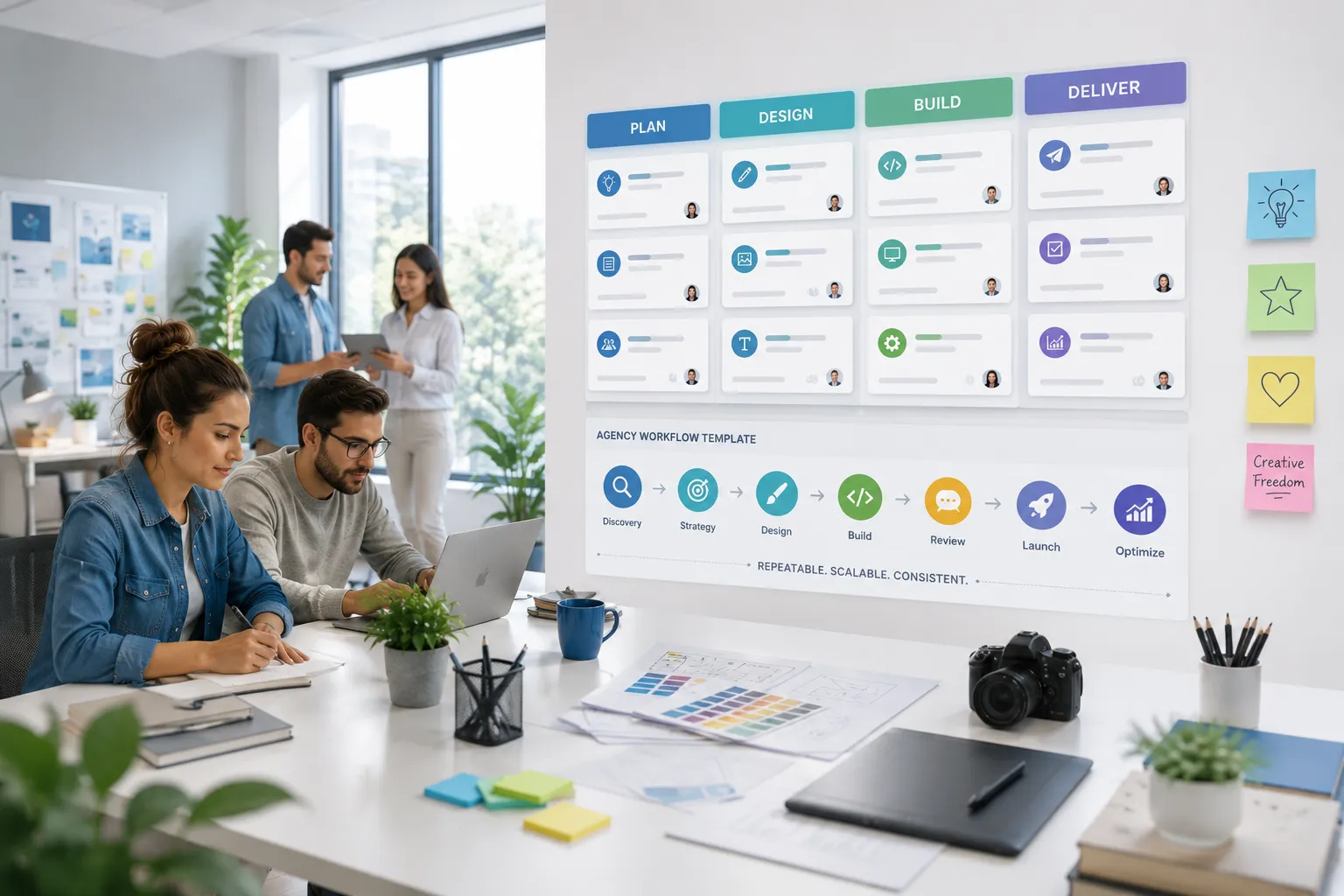
Your project stages. Define the standard path work moves through, from intake to done. Most agency projects fit a common flow — something like Intake/Brief, In Progress, Internal Review, Client Review, Revisions, Delivered — even across different service types. Naming these stages explicitly and using them consistently is the foundation everything else builds on, because it gives every project a shared shape.
Your intake and kickoff. A huge share of project problems trace back to a bad start — missing information, unclear scope, assumptions that surface as expensive rework later. A standard intake process (the same questions asked, the same information gathered, the same scope confirmed before work begins) prevents a disproportionate amount of downstream pain. This is one of the highest-return things to standardize because problems caught at intake are cheap and problems caught at delivery are expensive.
Your recurring deliverable types. Most agencies deliver the same handful of things repeatedly — a monthly report, a landing page, a campaign setup, a brand guideline doc. Each of these deserves a template: a checklist of steps, a definition of done, the standard components. You build it once and reuse it forever, and the quality floor rises because nothing gets forgotten.
Your handoffs. The moments when work passes between people — designer to developer, account manager to client, one stage to the next — are where things get dropped. Standardizing what a clean handoff includes (the work is at this stage, here’s what’s needed, here’s who owns it next) closes the cracks that improvised handoffs leave open.
How to actually build it (without a six-month project)
Standardization has a bad reputation partly because agencies imagine it as a massive documentation effort — months of writing SOPs nobody reads. It doesn’t have to be that, and it shouldn’t be.
Start by documenting what your best projects already do. You almost certainly have an implicit good process — the way things go when your most experienced person runs a project smoothly. Standardization often isn’t inventing a new process; it’s capturing the one that already works and making it the default for everyone. Watch a well-run project and write down what actually happens.
Build the process into your tools, not a binder. A standard workflow written in a document that lives in a folder is a standard workflow nobody follows. The version that works is one built into the system where the work actually happens — a reusable project board template with your standard stages already set up, checklists attached to recurring task types, handoffs that trigger the next step automatically. When the process is embedded in the workflow, following it is the path of least resistance instead of an extra discipline to remember.
This is a large part of why templated, reusable boards matter so much operationally. The GVenta Kanban Board is built around flexible boards and clear task ownership precisely so an agency can set up its standard stages and handoffs once and reuse that structure across every client project — turning your best process into the default that runs itself, rather than a document people are supposed to consult. The tool isn’t the point; embedding the process where the work lives is.
Standardize, then improve — treat it as living. A standard workflow isn’t carved in stone. The best agencies review their processes periodically and refine them as they learn. Standardization gives you something even more valuable than efficiency: a consistent baseline you can actually improve. You can’t optimize a process that’s different every time, because you have nothing stable to measure. Once the process is consistent, every improvement compounds across every future project.
The honest trade-offs
To keep this realistic: standardization has real costs and failure modes worth naming.
It takes upfront effort, and that effort competes with billable work. The payoff is real but it’s not instant — you’re investing now for leverage later, and agencies under acute delivery pressure often struggle to find the room. That’s a legitimate constraint, not a sign you’re doing it wrong; start small with the single highest-leverage process rather than trying to standardize everything.
And standardization can curdle into bureaucracy if you standardize the wrong layer or refuse to let the process evolve. The guardrail is the principle above: standardize mechanics, keep creative and strategic work free, and treat every process as improvable rather than sacred. A standard that no longer serves the work should be changed, not enforced for its own sake. Standardization is a tool for freeing your team, and the moment it starts constraining the actual thinking, you’ve over-applied it.
The bottom line
The agencies that deliver consistently, scale smoothly, and protect their margins aren’t the ones with the most heroic individuals — they’re the ones who’ve made their process boring and repeatable so their people can be brilliant where it counts. They standardize the mechanics of running a project ruthlessly, which is exactly what frees their teams to be creative and strategic in the work itself.
Process isn’t the enemy of good agency work. Improvisation is — it’s expensive, inconsistent, and it doesn’t scale. Build your standard workflow once, embed it where the work happens, keep improving it, and you turn your best project into your default project.
The GVenta Kanban Board lets agencies build their standard project workflow once — stages, ownership, and handoffs — and reuse it across every client, without a per-seat tax on the people involved. If you’re ready to stop reinventing your process, GVenta is worth a look.